
Introduction
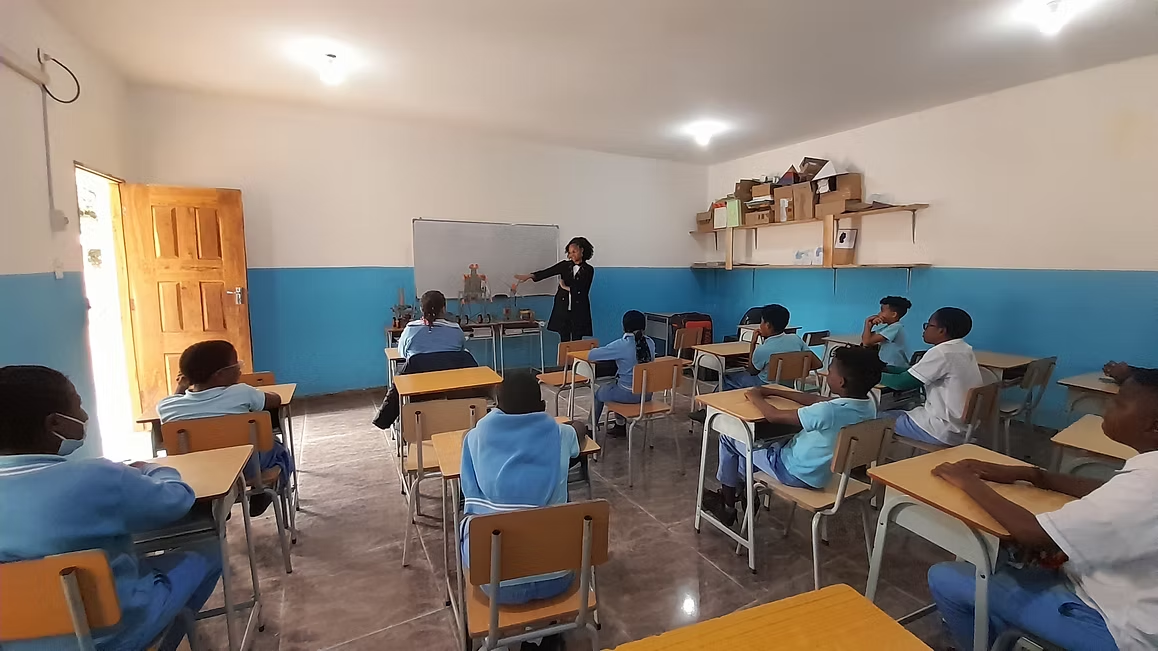
STEM—Science, Technology, Engineering, and Mathematics—is shaping the future across the globe. In Mozambique, the push for STEM education isn’t just about keeping pace with the rest of the world—it’s about empowering youth to participate in economic transformation, innovation, and the Fourth Industrial Revolution (4IR).
By integrating hands-on methods and skills-based learning, STEM education is becoming a critical lever for national development. This article explores why STEM matters in Mozambique and how communities, educators, and policymakers can support this vital movement.
Table of Contents
- The Global Imperative: STEM’s Role in Africa’s 4IR
- Why Mozambique Needs STEM Now
- STEM in Schools and Communities
- Barriers and Opportunities
- Computational STEM Innovation at UniRovuma
- Conclusion: Building a STEM-Driven Future
1. The Global Imperative: STEM’s Role in Africa’s 4IR
Africa as a whole stands to benefit immensely from the rise of the Fourth Industrial Revolution. STEM education is central to this transformation—advancing inclusive growth, fostering innovation, and building resilient economies (Wikipedia, YouTube, UN Trade and Development (UNCTAD), RSIF Paset). Mozambique, aligned with regional goals, is well-positioned to harness STEM for sustainable progress.
2. Why Mozambique Needs STEM Now
- Economic relevance: With over half a million youth entering the labor market annually—many lacking practical skills—STEM education and technical training are essential (World Bank).
- National strategy: STEM and science-technology-innovation (STI) parks are embedded in Mozambique’s long-term development plans (2015–2035), supported by public-private frameworks like the Maluana Science and Technology Park (UN Trade and Development (UNCTAD)).
3. STEM in Schools and Communities
- ASTROBOT Robotics Program: The ASTROBOT initiative, supported by ExxonMobil and the NGO Osuwela, trains students and teachers in robotics across 12 secondary schools in Maputo. It benefits approximately 200 students and 36 teachers—boosting programming, teamwork, and problem-solving skills—and culminates in interschool competitions (ExxonMobil).
- Non-formal community engagement: Osuwela’s broader efforts target both students and communities to make science accessible and engaging, with a particular emphasis on encouraging female participation in STEM (ExxonMobil).
4. Barriers and Opportunities
- Gender gap: Women remain underrepresented in STEM education and careers in Mozambique. Overcoming this requires addressing societal norms, fostering strong female role models, and creating inclusive learning opportunities (Macau Business).
- Systemic hurdles: Challenges include limited teacher training, infrastructure constraints, and coordination gaps across sectors. Targeted efforts in capacity-building and policy alignment are crucial (UN Trade and Development (UNCTAD)).
5. Computational STEM Innovation at UniRovuma
At UniRovuma, a cutting-edge computational mathematics initiative—backed by RSIF and other partners—is transforming higher education and research. Over 500 students and multiple lecturers have been trained in Python, data science, and mathematical modeling. The program emphasizes open-source tools and real-world applications such as geospatial analysis, risk mapping, and environmental modeling (RSIF Paset).
This project also promotes gender inclusion in STEM and strengthens partnered institutions, positioning Mozambique as a rising hub for applied STEM research and innovation.
6. Conclusion: Building a STEM-Driven Future
STEM education plays a vital role in Mozambique’s economic growth, innovation capacity, and social equity. From robotics clubs in schools to data science labs in universities, the impact is real—and expanding.
Call to Action:
- For educators and schools: Integrate hands-on STEM programs and forge partnerships with organizations like Stemmoz and Osuwela.
- For policymakers and funders: Increase investment in teacher training, curriculum reform, and inclusive initiatives to ensure equitable access to STEM opportunities.
- For communities and businesses: Support and mentor youth in STEM, especially girls, and champion real-world learning experiences.
Mozambique’s thriving young population and strategic commitment to innovation make it ripe for a STEM-driven future. Let’s build it together—through hands-on learning, equity, and forward-thinking collaboration.